
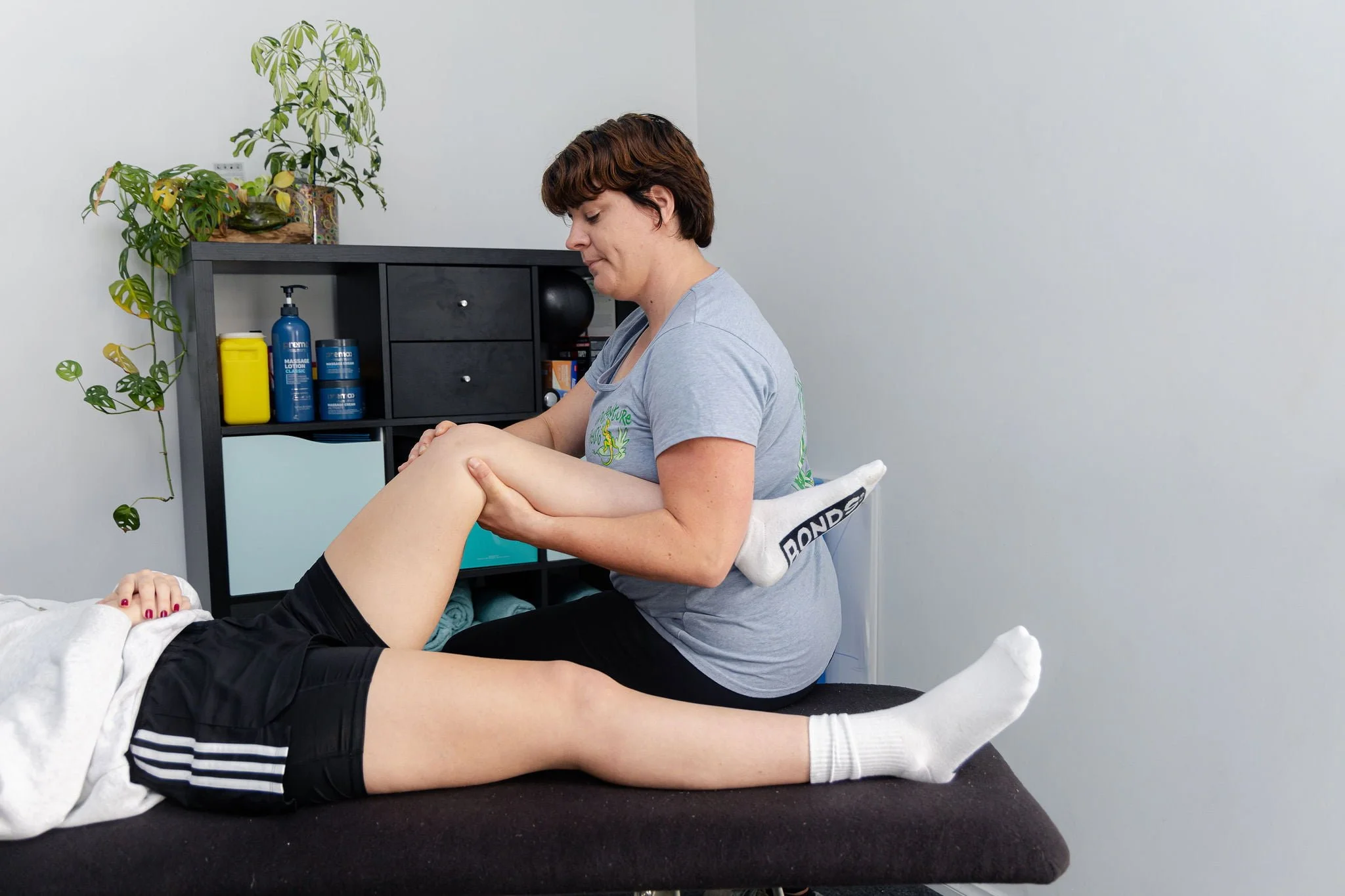
Is your knee shouting at you while you run?
Pain on the outside of the knee, just when your running was starting to click.
Here is what is happening, and a plan to get back to it.
— DOES THIS SOUND LIKE YOU?
You're finally finding your groove, building up your distance.
Then this showed up.
Iliotibial band syndrome (ITBS) is one of the most common running injuries, and it turns up most often in two kinds of people:
someone fairly new to running
someone who has just bumped up their distance.
If this sounds familiar, you're in the right place.
✔ Sharp or burning pain on the outside of the knee, sometimes down the outer thigh.
✔ It switches on at a predictable point in your run and forces you to stop or walk.
✔ Fine on the walk home, often fine the next morning, then back again on the next run.
✔ When it's really bad, you feel it even when you're not doing anything, until it settles, and then the pattern repeats.
✔ Downhills and stairs make it worse.
✔ You have been told to rest, foam roll, stretch, or just stop running, and none of it has actually fixed the thing.
— WHATS ACTUALLY HAPPENING
It is almost never a tight band you need to foam roll into submission.
You have probably already read that your IT band is tight and needs releasing. Here's what we've learned from decades of research on IT band pain. The IT band is a thick, strong sheet of tissue running down the outside of your thigh. You can't meaningfully stretch it out or roll it longer, and it was never really the problem.
What has usually happened is more simple. The tissue on the outside of your knee got loaded more quickly than it could adapt. New runners and runners who ramp up their distance quickly ask that area to tolerate a lot of repetition before it's had a chance to build up to it. It's irritable. It complains at a certain distance. For you, that might be every time you hit 3k or 6k. For someone else, it might be 10k.
The IT band is an adaptable structure that has just been overloaded and can be built back up. I'm here to help you learn how.
— WHY REST KEEPS LETTING YOU DOWN
Resting calms it. It does not build it.
So it comes straight back.
When you rest, the irritable tissue settles and the pain fades. It feels like you're on the mend and you're keen to get out there again. But rest on its own does nothing to increase how much load that area can tolerate, so the moment you run again you are right back where you started. This is the cycle most runners get stuck in: flare, rest, feel better, run, flare again.
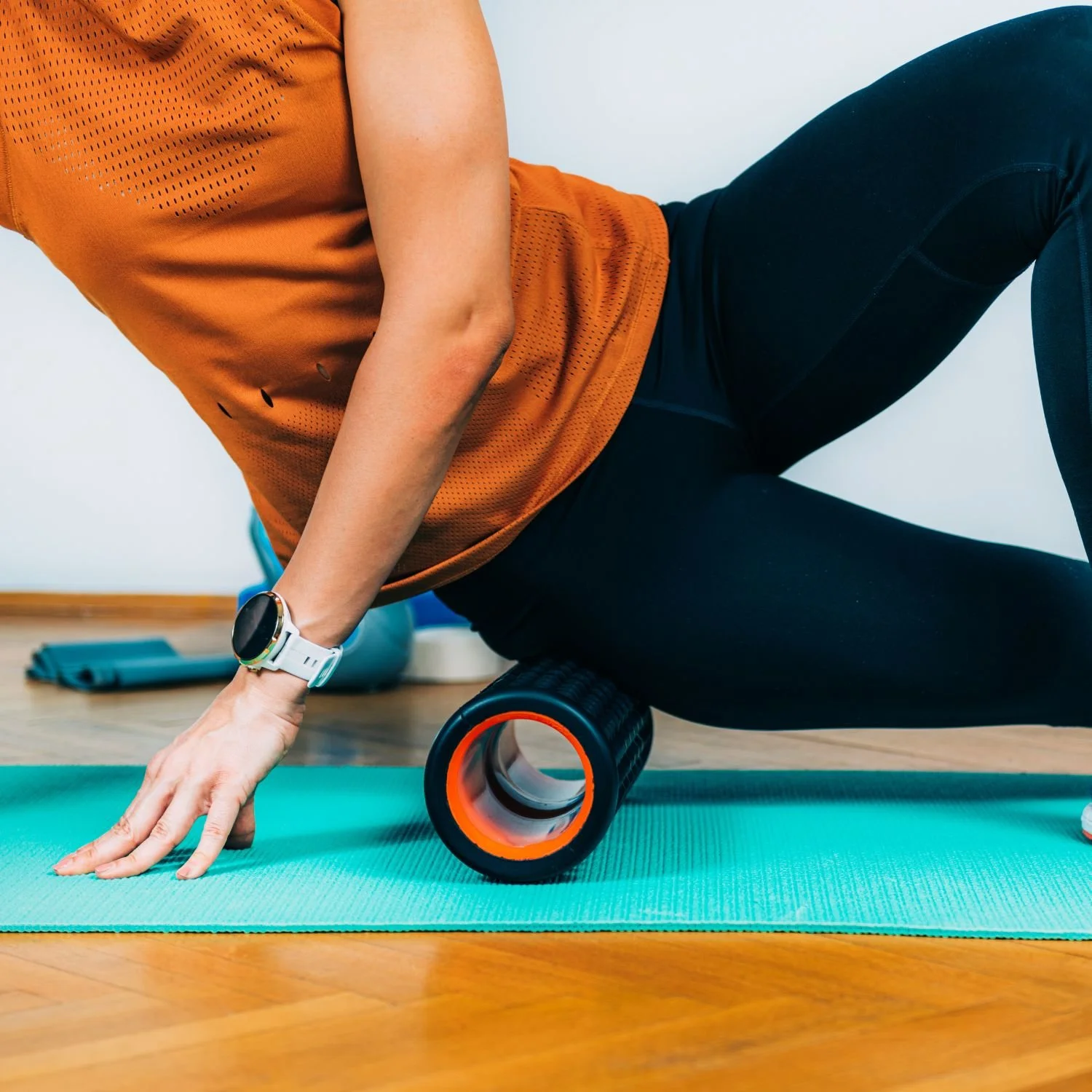
Foam rolling without strengthening and soothing has the same problem. It can feel like you are doing something useful, and it might dull things for an hour, but it does not change what is actually driving the pain. Stretching a structure you cannot lengthen is the same story.
Getting out of the cycle means finding a way to build the load tolerance back up, so next time you get out there, you're more resilient and won't end up crashing again.
— WHAT’S INSIDE
Four things no one has put together for you before.
This is a self-paced course you work through on your own time. Lifetime access, no app subscription. By the end you will understand your knee, know how to settle it yourself, have a rehab plan that meets you where you are, and a way back to running that makes you feel hope rather than dread.
01 UNDERSTAND IT
Learn what's actually happening
What ITBS really is and why it turns up in newer runners and runners who ramp up. You also work out how irritable your knee is right now (low, moderate, or high), which helps you know what level to start your rehab at, and what to expect for recovery time.

02 SETTLE IT
Treatment you can do yourself
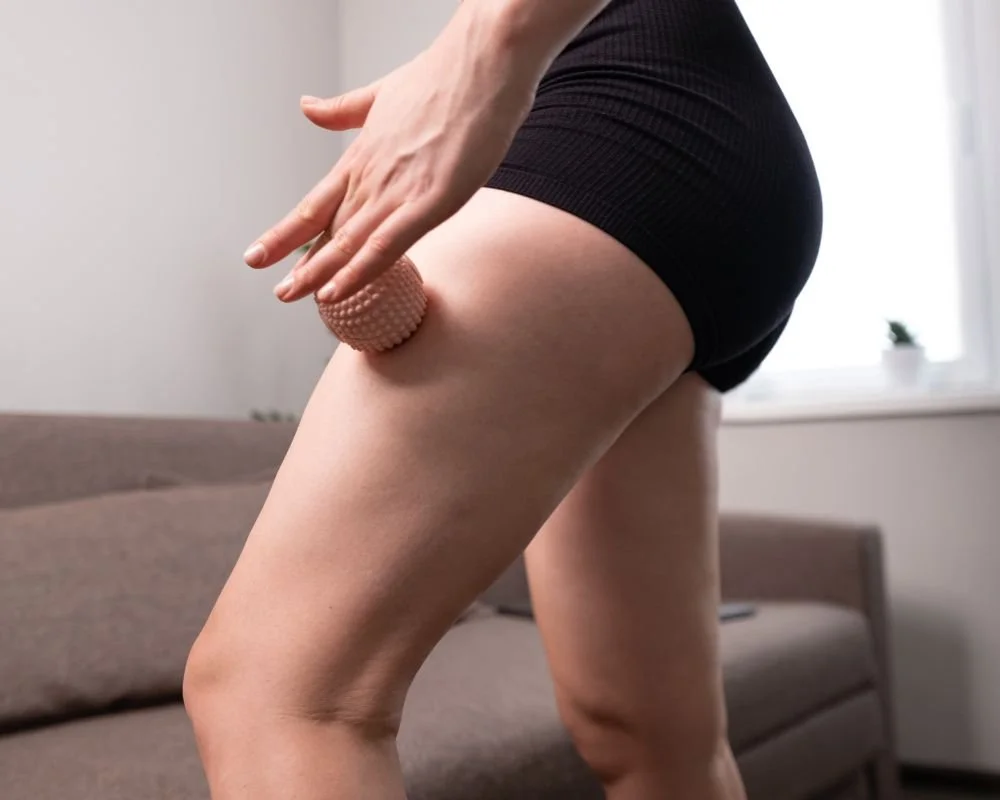
The things that actually calm an irritable knee, done properly and for the right reasons, so you are not just chasing short-term relief. At Adventure Physio I live by the motto: "Calm it down, then build it up." This is the calm it down part.
03 BUILD IT BACK
A progressive rehab plan
Rehab that builds your knee's tolerance back up, in the right order and matched to how irritable it is today. I teach you the reasoning behind each exercise so you know why you are doing it and when to move on. This is the magic that a generic exercise sheet or asking ChatGPT can never give you.

04 GET BACK OUT THERE
A return-to-run plan
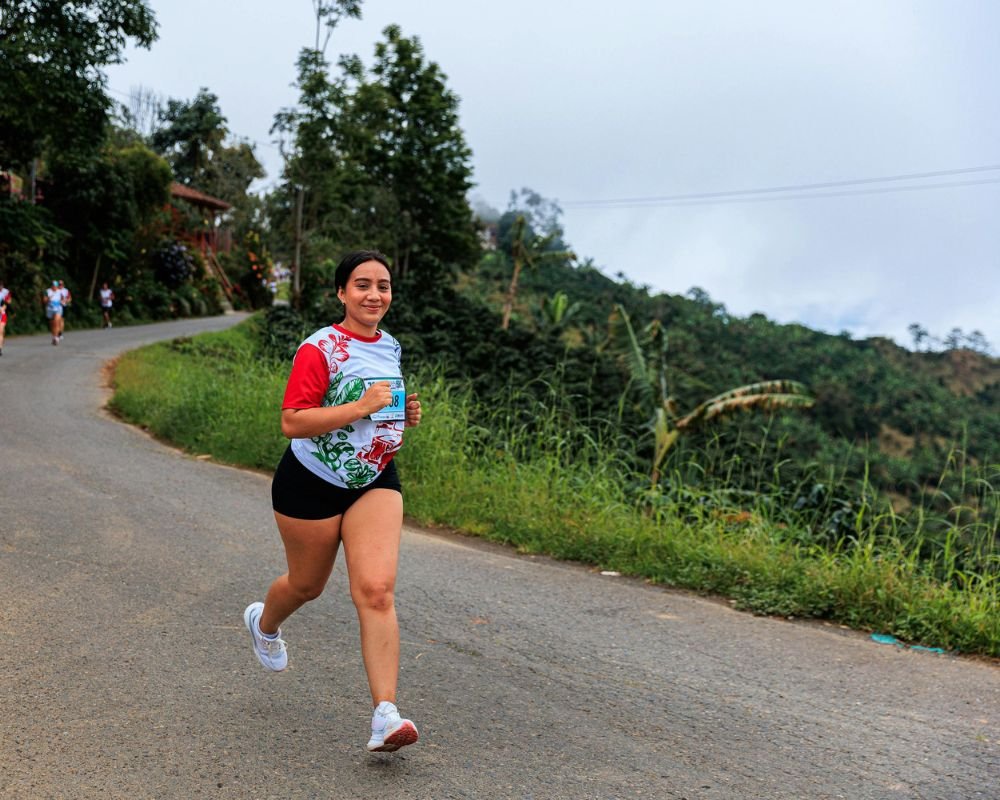
How to reintroduce running without re-entering the flare cycle. This might be the most important part and the part everyone rushes. It's often a big reason the pain keeps coming back.
— IS THIS RIGHT FOR YOU
Built for one specific problem.
THIS IS FOR YOU IF:
You want to understand it and run your own plan
You are newer to running, or have recently increased your distance.
Your pain is on the outside of the knee and behaves the way described above.
You would rather understand what is going on than be handed a sheet of exercises with no reasoning.
You are willing to do the work between now and your next start line.
SEE SOMEONE IN PERSON FIRST IF:
Your knee is doing something this course does not cover
It locks, gives way, or swells up.
The pain started with a specific injury, twist, or fall.
The pain is deep inside, underneath, above, behind, or across the front of the knee rather than the outside.
Something just feels wrong and you want eyes on it.
If you are local to Bibra Lake, Perth and would rather have hands-on help alongside this, you always have somewhere to come back to. Book In Here
— WHO’S BEHIND IT
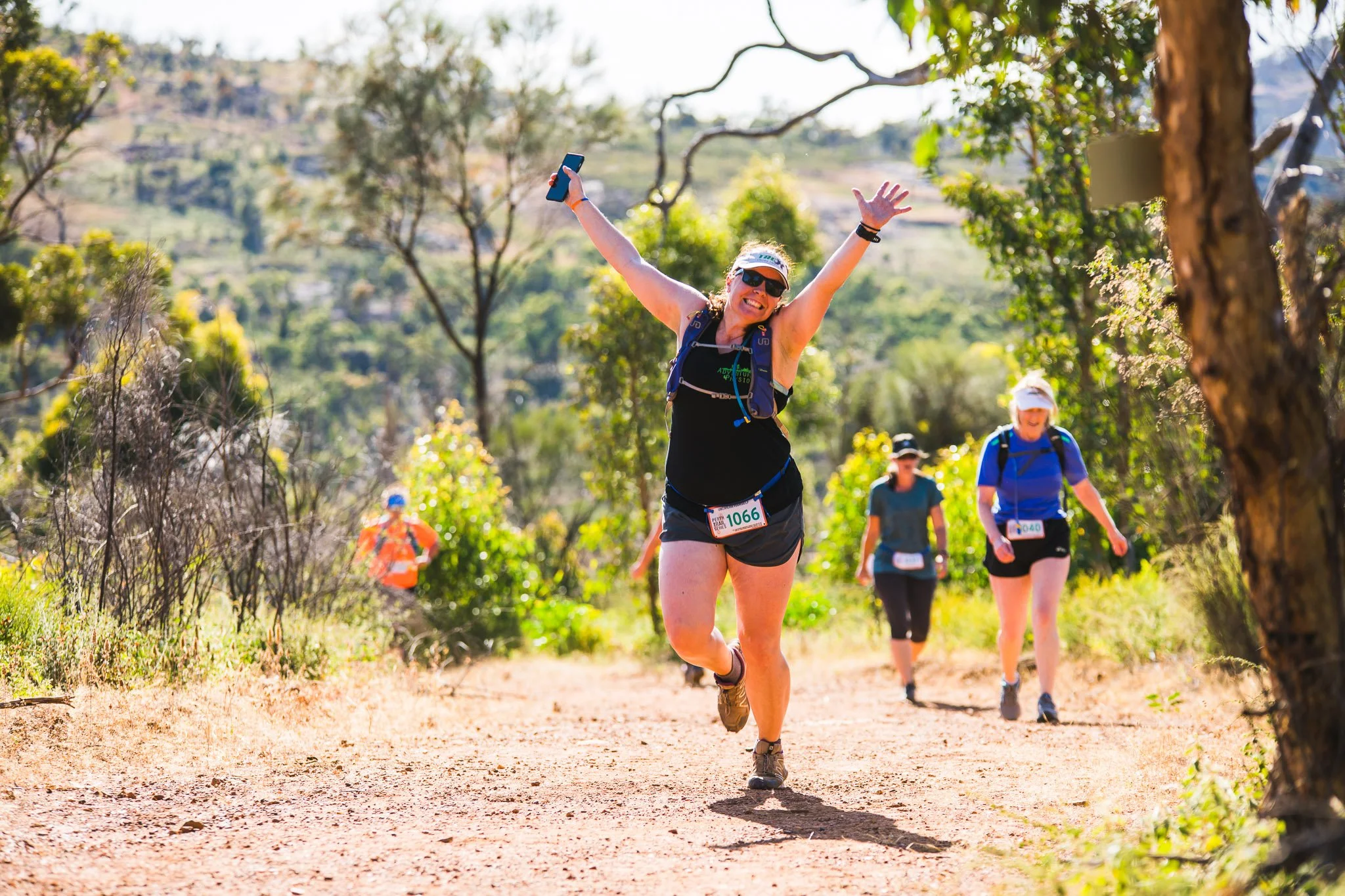
I'm Steph.
I built this because ITBS is frustrating but fixable, and I want to empower you to get out there enjoying life again.
I run Adventure Physio in Bibra Lake, working with active people who are not willing to give up the things that keep them sane.
ITBS is one of the most common problems I see in runners, and it can be incredibly frustrating if you don't understand what's going on. Most people arrive having been told to rest, stretch, and roll, having done all three, and having got nowhere.
What actually works is understanding what is driving the pain and then building the area back up in the right order.
It isn't too complicated, but it does need to be done properly and in the right sequence and at the right pace. This course is that plan, laid out so you can run it yourself.
The questions most runners have
-
That depends on how irritable things are right now, and how long they've already
been sore for. The course starts by having you work that out. I give you an honest timeline for each stage so you are not guessing. While
I can do my best to give you accurate timelines, it also depends on how consistent you are with the plan and how your body responds to the return-to-running phase.
Sometimes this takes longer for some people, and ITBS isn't a condition that can be rushed.
-
The early stages need very little. Later stages progress into loading that works best with some weight or resistance.
I give you options for dumbbells or barbells depending on what you have available, but you will need to use some weights to get the most out of this program.
-
I honestly believe that being in front of an expert who can see and feel what's going on with their own eyes will always be the best option.
This program will never replace someone giving you hands-on treatment, or rehab exercises that meet you where you're at.
There are also other conditions that can be misdiagnosed as ITBS, which might need a professional to diagnose, and this program won't be able to offer you that.
That said, there are all kinds of reasons you might not want to or be able to see someone in person, and for those times this is a plan you can run yourself.
The course also has a module called "when to see a physio" to help you decide if you need extra support.
-
The course is upfront about what ITBS looks like and what it doesn't.
If your knee is doing something outside that picture, the course tells you plainly and points you to getting it looked at in person.
Better to know early than to waste weeks on the wrong plan.
-
It's close. Joining the waitlist is how you find out the moment it's live, before anyone else.
-
First access when the course opens, at the $39 launch price, and nothing you did not ask for.
Just the heads-up when it's ready, and news about future courses launching.
Get back to the run you were building toward.
ITBS is common, it is understood, and it is changeable.
Here is the plan.
Physiotherapy for active people, Bibra Lake WA
This course is general education, not personal medical advice, and does not replace an individual assessment.
If your symptoms are severe, worsening, or do not fit what is described here, see a health professional in person.
Adventure Physio acknowledges the Whadjuk Nyoongar people as the Traditional Owners of the lands and waters where Perth is situated today.