

Sports Injuries: What to Do in the First Few Hours
I used to play roller derby and worked as a team physio for rugby and soccer teams. I’ve seen a lot of contact sport injuries - some handled well, some… really not.
Here’s what to do (and not do) in those first crucial hours after getting hurt.
We'll talk about:
concussions
suspected fractures
muscle tears and strains
ligament and joint injuries and sprains
CONCUSSION:
A head injury that can happen after hitting your head in a fall, a tackle or being knocked by someone else.
I once watched a rugby coach get obviously concussed mid-game when he jumped on field to play for the first time in a long time. He refused to stop playing.
He spent the entire half swerving all over the field, couldn’t track the game or the ball. Players on both teams did their best to avoid him and not include him in play, but he wouldn’t listen to anyone telling him to get off.
After the game? He went out drinking with the team (I couldn’t think of anything worse than alcohol to add to a head injury, other than another head injury.)
This is the problem with concussions: people are often so desperate to keep playing or mountain biking or doing the fun thing they’re doing that they underestimate how serious it is. And because they’ve just sustained a head injury, they’re less logical and can’t rationalise or make good decisions anymore.
Why stopping matters:
If you keep playing with a concussion, you’re physically and cognitively impaired. That makes you more likely to get hit again.
A second head injury on an already inflamed or swollen brain means an even worse injury and can lead to post-concussion syndrome - which can take months to years to heal.
Not to mention, you’ll probably be making some pretty terrible decisions and become more of a liability than an asset to the team.
The culture around concussions has shifted in the last 5 years, but I’ve still seen people do some scary things.
Common early symptoms of a concussion, which can happen minutes to hours of a head injury, include:
headache or “pressure” in the head
confusion
dizziness
nausea
memory loss regarding the event
other common signs include blurred vision, light/noise sensitivity, fatigue, and appearing dazed
What to do:
STOP PLAYING - non-negotiable with any of the symptoms listed above
No alcohol for at least 24 hours (ideally longer)
No aspirin or anti-inflammatories (NSAIDs) - paracetamol only for headache
Rest in a quiet, dim environment
Go to emergency if:
Loss of consciousness or fainting
Convulsions or seizures
Severe headache that’s getting worse
Repeated vomiting
Confusion or can’t recognize people/places
See a professional if:
Any symptoms lasting more than 12 hours
Symptoms getting worse instead of better
you continue to have trouble either sleeping or staying awake
SUSPECTED FRACTURES
Common ways to break bones in contact sports:
Falling on an outstretched hand (wrist, arm, collarbone)
Direct impact or collision (ribs, fingers, nose)
Twisting injuries (ankle, foot)
How to tell if you might have broken something:
Some fractures are obvious - you’ll know. Others, like ankle injuries, can be harder to tell apart from a bad sprain. Some symptoms:
Obvious deformity
Severe pain that doesn’t settle
Can’t bear weight or use the body part
Significant swelling
When to go to emergency or urgent care:
Any suspected fracture needs X-rays. Don’t try to “wait and see” - early diagnosis matters.
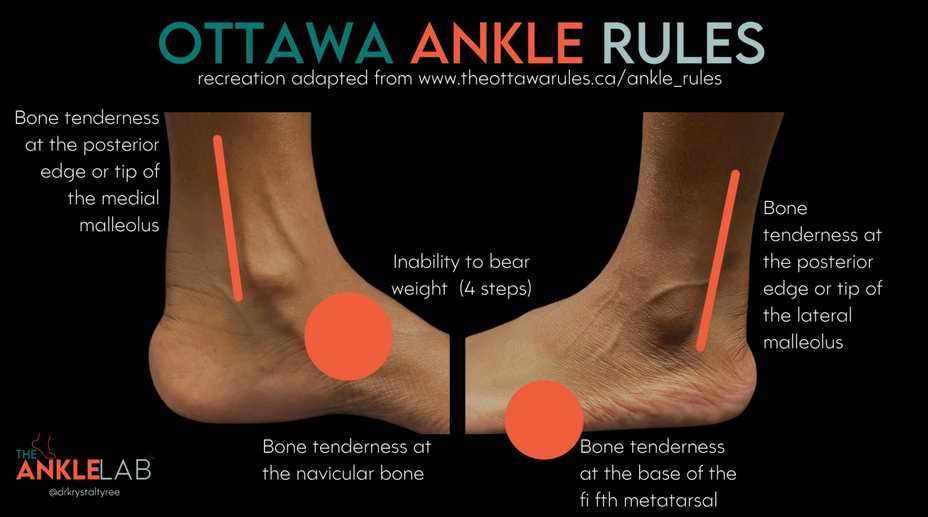
For ankle injuries specifically - Ottawa Ankle Rules:
Everyone’s twisted an ankle playing sports. But how do you know when it’s just a sprain or actually broken?
These guidelines help you figure out if you need an X-ray:
Go to urgent care or emergency if you have ankle or foot pain AND any of these:
Bone tenderness in the shaded areas shown in the diagram below
You can’t take 4 steps bearing weight on that foot, both right after injury and now
MUSCLE TEARS AND STRAINS
How to tell if you might have a muscle tear:
You heard a noise like a pop or tear when it happened
Bruising and swelling in the area
The muscle feels really tight and often painful
Pain is in the middle of the muscle, not the joints on either side
Avoid HARM in the first 48-72 hours:
Heat - no hot showers, heat packs, or saunas
Alcohol - it increases swelling and delays healing
Running - or any activity that aggravates it
Massage - this is the one everyone wants to do
Why avoid massage?
Everyone wants me to rub the sore spot. Don’t.
Think of it like a scab on your arm - you wouldn’t rub that. If you did, it wouldn’t heal properly. You’d break up the scab and scar tissue that’s helping it heal.
It’s the same inside after a muscle tear - you just can’t see it.
What to do instead:
Gentle movement within comfort levels
Compression
Elevation when resting
See a professional if:
Pain lasting more than 3 days
Large areas of swelling or bruising
You heard a pop or felt a tear at the time of injury
Weakness that doesn’t improve
JOINT INJURIES (SPRAINS)
Joint injuries follow the same HARM rules as muscle tears - no heat, alcohol, running, or massage in the first 48-72 hours.
What to do instead:
Follow the PEACE & LOVE protocol (detailed HERE):
Protect, Elevate, Avoid anti-inflammatories and ice, Compress, Educate
Load gradually, Optimism, Vascularisation, Exercise
See a professional if:
Joint feels unstable or gives way
Significant swelling that doesn’t improve in 24-48 hours
Can’t bear weight
Pain lasting more than 3 days
You heard a pop or crack when injured
Dislocation warning signs:
Obvious deformity
Inability to move the limb
Numbness or tingling (nerve compression)
If you suspect a dislocation, go to emergency.
The two golden rules:
When in doubt, get it checked. Early assessment often prevents bigger problems down the line.
Early, gentle movement (except suspected fractures)
Even for concussions- I need to emphasise the gentle here. This might be a slow walk around the block or a gentle paddle in a calm beach.
For all the other sorts injuries except fractures, we want to be gently moving the affected body part a little bit. gentle ankle circles on a sprained ankle, gently bending the knee of a hamstring tear. We’re not stretching, not pushing, not doing any heavy lifting but we do want to support some healthy blood flow.
To summarise: gentle, gentle, gentle but MOVE.