

Twisted an ankle? Put down the ice pack.
Twisted an ankle? Tweaked a shoulder? Sprained your knee and now it’s a red, hot, painful balloon?
I've sat through a yearly first aid course since I was 16, and every single time they get to the RICE protocol, I have to bite my tongue.
Rest. Ice. Compress. Elevate. Pop some anti-inflammatories. It's been drilled into us since we were kids. Sports teams still teach it. Hospitals still recommend it. And it's... not great advice.
Sadly, the guy who did the original research on RICER has spent the last 10 years trying to rewrite the public narrative and refute his original research. My favorite quote: “Although popular, the implementation of this protocol to attenuate the recovery process is unsubstantiated. There is, however, an abundance of research that collectively supports the notion that ice and rest does not enhance the recovery process, but instead delays recovery, and may result in further damage to the tissue.” See more here
So what should you do instead?
The current best practice is called PEACE & LOVE. (I know… it sounds like a hippie bumper sticker, but what can you do? 🤷♀️)
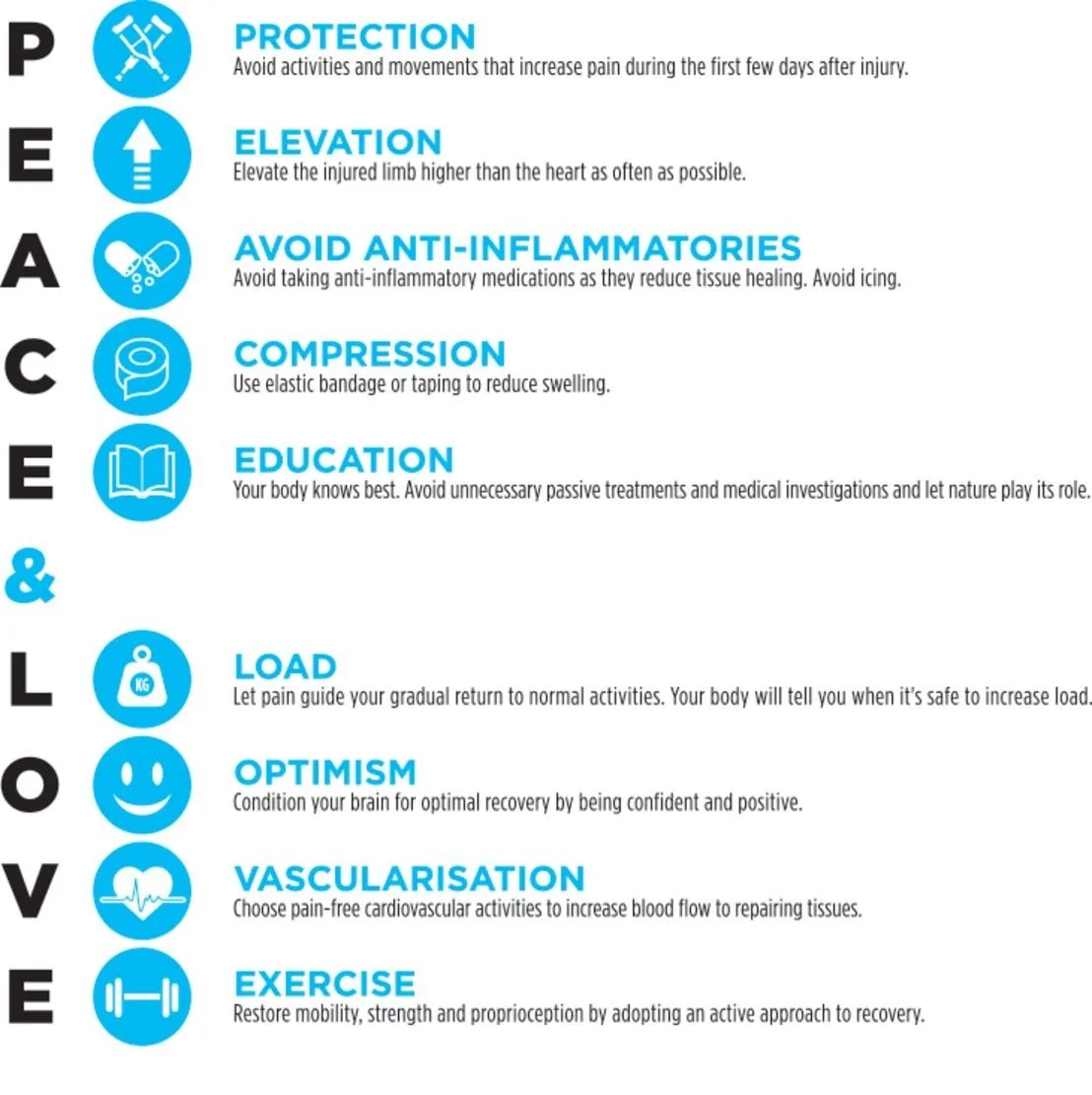
PEACE: the first 1–3 days
Protect - Avoid movements that clearly aggravate it. If you can't walk, use crutches. A brace might help early on.
Elevate - Prop it up when you're sitting around.
Avoid anti-inflammatories and ice - More on this in a sec.
Compress - Use compression to help manage swelling.
Educate - Get proper advice. Know what's normal, what's not, and what you can safely do.
LOVE: the recovery phase
Load - Gradually start using it again. Even small movements count.
Optimism - Your body is a healing machine. This will get better.
Vascularization - Get your blood moving. Movement helps.
Exercise - See a physio for the right rehab exercises.
In defense of ice…
If ice gives you enough pain relief to actually move, then please, use it. But ice doesn't stop swelling or reduce inflammation.
What it actually does is vasoconstrict - it reduces blood flow to the area. And blood flow is what you need to clear out the swelling and bring in the good stuff for repair.
Swelling and inflammation aren't mistakes your body is making. They're part of the cleanup and rebuild process. When we ice aggressively or pop NSAIDs (Neurofen, Voltaren, etc.) in the first few days, we're interfering with that process.
A note on anti-inflammatories
When we use anti-inflammatory medication early (Neurofen, Voltaren, NSAIDs, etc.), we interfere with the body’s natural healing response.
However… if you're going to do it, do it properly. Take it as a course for a few days, not just when you remember or when the pain gets bad. Spot-treating doesn't really work.
That said - I also believe you know your body better than I do. I just know a lot about bodies in general. If something genuinely feels helpful to you, I'm not going to tell you to stop unless I know it's actively harmful.
Movement matters more than you think
As soon as it's safe (usually within a day or two):
Start gentle movement
Keep the rest of your body active
Gradually return to using the injured area
Focus on what you CAN do, not what you can't
Movement gets blood flowing. Blood brings oxygen, nutrients, and healing signals to injured tissue.
Sometimes a short walk, an easy bike ride, or gentle arm circles can make things feel noticeably better, even if it's not perfect. Of course what movement you chose depends on the body part you injured.
Healing takes time. But what you do in the first week plays a huge role in how quickly and how well you recover.
Pain management still matters.
If ice helps reduce pain, you should use it so that the gentle movement needed for healing is possible.
But if you’re forcing yourself to ice an area, it’s probably not doing much for you.
The R.I.C.E Protocol is a MYTH: A Review and Recommendations https://thesportjournal.org/article/the-r-i-c-e-protocol-is-a-myth-a-review-and-recommendations/
Soft-tissue injuries simply need PEACE and LOVE https://bjsm.bmj.com/content/54/2/72